Mower parking checklist
Ready, place, and season the exact machine
01Make it ready
- Shut down, wait for moving parts to stop, and allow the mower to cool
- Use the manual's start-control, key, or battery-removal procedure
- Clean grass and debris only with the documented method
- Stop for fuel odor, leaks, damaged wiring, or an abnormal battery
02Place it
- Tape the complete stored footprint with vehicles parked
- Keep clear of doors, tracks, appliances, panels, steps, and walking routes
- Use a dry, level position that keeps the machine stable and visible
- Fold, stand, hang, or restrain only when the manufacturer supports that configuration
03Prepare for the season
- Follow the exact fuel or battery storage procedure and temperature limits
- Complete the model's scheduled maintenance and recall check
- Record the service state and return-to-use inspection date
- Route fuel, oil, batteries, and unwanted equipment through approved local programs
Field note: The mower, engine, battery, charger, fuel container, and local fire or waste rules may each have separate instructions. When they differ, use the most specific applicable direction.
The direct answer: store the exact mower, not a generic shape
A lawn mower can occupy a garage only when the machine's instructions, condition, power source, and proposed position all support it. Start with the model and serial number, then find the current operator's manual. Walk-behind, riding, gasoline, electric-start, and battery mowers do not share one shutdown or storage procedure, even when two machines appear to have similar decks and handles.
Before every return to storage, shut the machine down, wait for moving parts to stop, and allow it to cool as the manual directs. Remove or disable the start control only in the way specified for that model. If you smell fuel, see liquid under the machine, find damaged wiring or a swollen battery, or cannot confirm that the blade has stopped, keep people away and follow manufacturer or qualified-service guidance instead of parking it as usual.
Measure three storage positions before buying hardware
Record the mower's full operating footprint first: deck or tractor width, wheel-to-wheel length, handle position, discharge chute, bagger, cables, controls, and the space needed to approach it. Then measure only the alternate positions the manual actually permits. A folded handle can reduce length without making the machine safe to stand upright; a removable bagger can change the footprint without changing service access.
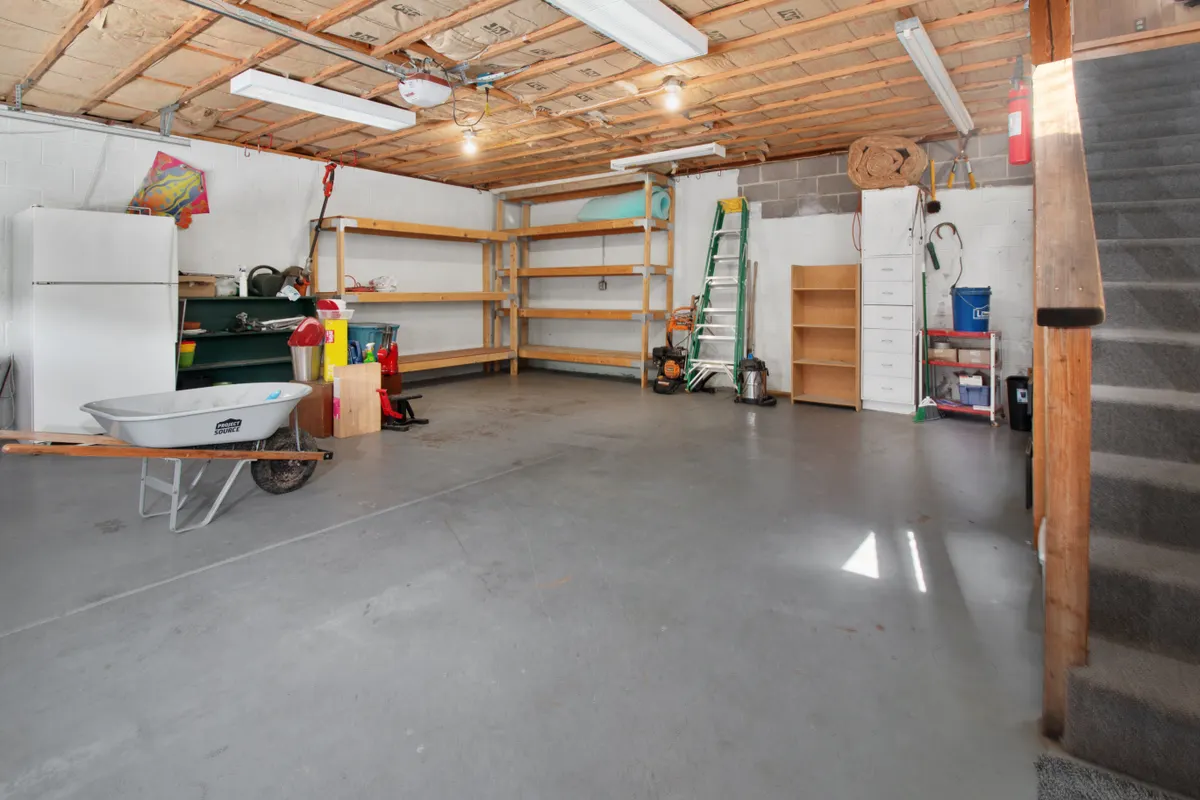
Tape each approved footprint on the floor with the vehicles parked and the garage door fully open. Open car doors, carry groceries to the house, move trash carts, and approach the mower from its normal retrieval side. Leave the garage-door tracks, opener, electrical panel, appliances, outlets, floor drain, steps, and service routes unobstructed. The best bay is the smallest position that remains stable and easy to inspect—not the position that hides the most machine.
- Operating position: the baseline for models that must stay level
- Handle folded: only with the manual's cable routing and lock sequence
- Vertical position: only when the exact model is designed and prepared for it
- Riding mower: include attachments, turning access, parking brake, key, and service clearance
- Seasonal position: include the space needed to inspect, maintain, and return the mower to service
Separate the gasoline decision from the machine footprint
For a gasoline mower, inspect the tank, cap, fuel lines, carburetor area, and floor for signs of leakage before storage, without dismantling anything the manual does not instruct you to service. Toro's operator manual directs users to let the machine cool, clean grass and debris, clean up fuel or oil spills, and avoid storage near an open flame, spark, or pilot light. Use those principles only alongside the manual for your exact engine and mower.
A portable fuel can is a separate storage decision. The U.S. Consumer Product Safety Commission says portable fuel containers belong in cool, well-ventilated areas, closed, out of children's reach, and away from ignition sources; it also says never to keep gasoline inside a house or basement. An attached garage is not automatically an acceptable answer. Follow the container label and applicable local fire guidance, and ask the local fire authority when the location is uncertain.
Give a battery mower a model-specific battery route
Do not treat an electric mower as hazard-free merely because it has no gasoline. Follow the mower, battery, and charger manuals for shutdown, battery removal, cooling, charging, temperature, moisture, and long-term state of charge. Keep terminals away from loose metal and keep charger vents clear. A battery that is cracked, swollen, leaking, unusually hot, wet, recalled, or otherwise abnormal should not return to the normal charging station.
Manufacturer storage limits differ. The EGO LM2200SP manual, for example, publishes a recommended storage-temperature range for that specific mower. That number is not a universal lithium-ion rule and should not be copied to a different pack, charger, or machine. Record the exact model numbers and keep their manuals with the garage plan so the battery route can be checked again during heat waves, freezes, and seasonal shutdown.
Stand a mower vertically only when the manual says so
Vertical storage is a designed feature, not a position to improvise with straps or wall hooks. A current Toro manual allows a named model to use a vertical-stow position only after model-specific fuel, cutting-height, handle-lock, and cable-routing steps; the same manual warns not to stand a fuel-and-oil machine vertically unless it was designed for that purpose. That is the useful rule: confirm the exact model, then follow every preparation step in order.
Do not hang a mower from its handle, guard, deck opening, or transport point unless the manufacturer documents that load and orientation. Do not lean a heavy machine where a child, vehicle, or opening door can tip it. If the compact position makes leaks harder to see or requires lifting beyond the user's control, store the mower level or choose a different location rather than forcing the space-saving idea.
Build a parking bay that makes inspection easy
Choose a dry, level surface with enough light to inspect the machine and floor. Keep the mower out of puddles, vehicle-tire paths, the route into the house, and the swing of doors or stored ladders. Protect it from impact without sealing a hot, wet, or fuel-smelling machine inside a tight enclosure. Any mat, cover, rack, wall stop, or wheel restraint must suit the exact equipment and preserve required ventilation and access.
Store keys, removable start buttons, and approved battery packs according to the manual and household-access needs; never leave a start control where a child can operate the machine. Keep the operator's manual, model number, serial number, purchase record, and service contact in a visible garage file. A simple label for 'cooling,' 'ready,' or 'needs service' prevents another household member from moving or charging a machine that has not passed inspection.
Use two routines: after every mow and before the off-season
After each use, follow the manual's shutdown and cleaning method, remove grass and debris from the approved areas, inspect guards and controls, and let the mower dry before its final position. Do not reach under a deck, tip the machine, handle a blade, use water, disconnect fuel, or open a battery housing unless the manufacturer provides that procedure and the required precautions.
Before long storage, use the model's maintenance schedule rather than a universal internet recipe. One gasoline engine may call for fresh stabilized fuel for a limited period; another procedure may require running the tank dry in a specified way. Battery instructions may call for a particular charge state, removal step, and temperature range. Record what you completed and schedule the return-to-service inspection before the first spring cut.
Stop storing and choose the proper service or disposal route
Remove the mower from routine use when there is a fuel or oil leak, persistent fuel odor, damaged safety control, cut cable, cracked deck, unstable wheel, battery abnormality, charger damage, or an active recall. Do not test a suspicious machine inside the garage. Use the manufacturer's service network or qualified repair guidance, and check the model and serial number against official recall information before returning it to use.
Fuel, oil, damaged batteries, and unwanted equipment can require different local routes. The U.S. EPA advises following product labels, keeping hazardous household materials in original labeled containers, never mixing leftovers, and checking with local environmental or solid-waste agencies. Do not pour fuel or oil into a drain, onto the ground, or into a storm sewer, and do not place a damaged battery in household trash or recycling without the applicable local and manufacturer instructions.
Primary references
These sources support safety, disposal, or specification details used in this guide.